Making confident business decisions isn’t about having more certainty — it’s about building a repeatable process for weighing benefit, alternative, and data, so you stop either overthinking every angle or deciding under pressure. Do that consistently, and the sleepless nights spent circling a decision get replaced by a process that actually moves you forward
You’re staring at the same decision you were staring at three days ago. You’ve mapped out every angle — what happens if it works, what happens if it doesn’t, what happens six months from now if you’d said yes, what happens if you’d said no. You are, if anyone’s counting, four steps ahead of a decision you haven’t actually made yet.
And you still haven’t moved.
What if I choose wrong? What if this costs me money, or clients, or the small, hard-won momentum you’ve spent years building? What if you commit — go properly all in — and it doesn’t work, and you’re back exactly where you started, except more tired?
It’s exhausting — and if this sounds like a cousin of feeling overwhelmed running a small business, that’s because it is. It’s the opposite of what confident business decisions actually feel like — carrying every possible outcome at once isn’t thoroughness. It’s a full-time job with no pay-off.
Here’s the myth worth burning down: confident decision-makers don’t “just know.” Nobody does — not the founder running a single boutique, not the person three tiers up in corporate leadership signing off on a strategy deck. Everyone is moving through the day making one decision at a time, from whatever information they’ve got, trusting a muscle they’ve built rather than a gift they were born with. Confident business decisions aren’t a personality trait. It’s a rep count 🏋️♀️
And the overthinking and the impulse-lunge you sometimes catch yourself doing? Same root cause. Both are what happens when there’s no repeatable process to lean on. Without one, uncertainty either spirals into endless planning (freeze), or gets so unbearable you skip straight past due diligence just to make the discomfort stop (lunge). Neither is a character flaw. Both are what happens in the absence of a process.
The Process Behind Confident Business Decisions
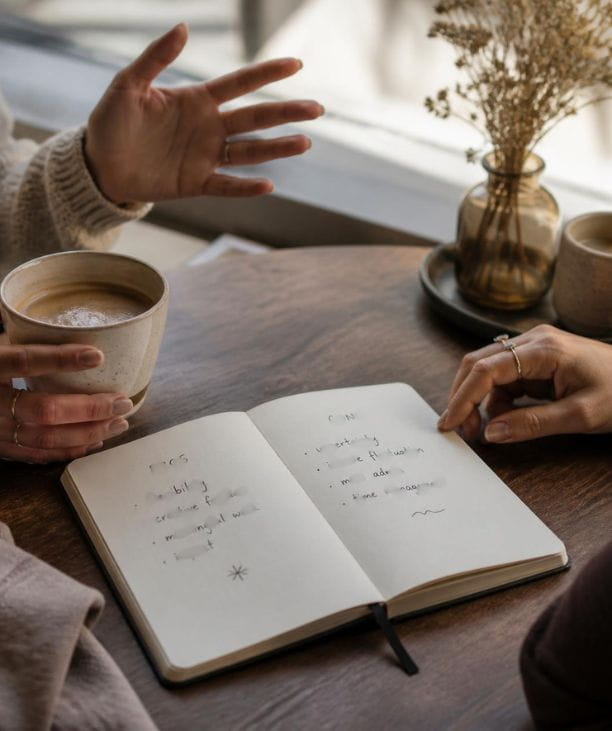
When a client’s stuck, we don’t start with fluffy questions like “what does your gut say.” We get straight into turning feeling into something you can actually weigh:
- What’s the immediate benefit — of this investment of time, energy, or money?
- What’s the benefit longer-term, and does it actually align with your bigger vision and your values, not just this month’s panic?
- What’s the alternative? What does the business look like in a week if you don’t do this. In three months. In six months. In a year.
- What does the data already know — the measurable levers you can actually see? Because you don’t keep pouring resources into something you already know isn’t working. Don’t throw good money after a mediocre opportunity.
Saying it all out loud does something having a conversation with yourself in your own head never does — it reveals the shape of the problem from a different angle, often one you couldn’t see while it was still just noise in your mind.
I watched this happen recently in a HiveMind session. A client had spent over a year — and hundreds of pounds a month in technical subscriptions — building an online course. She was creative, capable, and completely bogged down learning platforms rather than actually creating. So I asked: what’s the lowest-effort way you could deliver stage one, right now, today? We landed on the answer together, at the same moment: email. She could cancel every subscription, deliver the content in a simple sequence, and let people drop in wherever suited them. The decision that had felt impossibly tangled for a year became obvious in about four minutes — because we’d finally looked at time, money, energy, and business impact together, out loud, instead of alone, in her head.
I know this pattern intimately, because I’ve lived both sides of it.
At Odyssey (my original brick & mortar business), offered an opportunity to contribute my expertise and build some brand awareness, I was already four steps ahead — mapping the after, the optics, the ripple effects — instead of simply being present and delivering excellent work in the moment. The overthinking didn’t protect me. It just meant I gave away brain space I never got back, on things that hadn’t happened yet and mostly never did.
And the flip side cost me more. Every time I made a fast call under pressure — usually the moments I’d finally admit I needed help and reached for the first available answer — I skipped the due diligence. I didn’t ask enough questions. I didn’t set clear expectations before committing. More than once, that taught me the hard way: pressure is not a strategy, and neither is skipping the conversation just to feel like you’ve “done something.”

What Changes When Confidence Becomes a Habit
Build this muscle, and everything changes. You get quicker at reading the data you already have. Faster at weighing what actually matters against what’s just noise. And — crucially — more confident in your own intuition, not less, because now it’s backed by a process you can trust because you’ve worked through it before.
One more thing: be careful whose advice you take on the way there. Is the person guiding you actually living the outcome you want, running a business the way you’d want yours run? If not, take it with a healthy pinch of salt, and trust your own intuition and your own data instead.
You don’t need to wait for certainty. You need a legitimate process you trust more than the fear.
This Is What Confidence Actually Looks Like
Imagine what becomes possible when you’re no longer rehearsing every possible outcome in your head at once. When a decision arrives and instead of spiralling forty-seven steps into an imagined future, you’ve got a process — one that takes minutes, not months, and leaves you clear-headed and energised, not more exhausted.
You start moving faster because you trust the muscle you’ve built. You stop mistaking overthinking for thoroughness, and pressure as a symptom of entrepreneurship. And the decisions you do make — you make them once, properly, instead of circling back to the same one for the third week running.
That’s what confident business decisions actually look like when you’re working with a small business mentor who’s building that muscle alongside you. Not certainty. Capability.
Feeling like every decision needs a five-year forecast before you can move? Start smaller. Grab the free 20-Minute Focus Audit and find the one thing that actually needs your attention right now — not everything, just the one thing.
👉🏼 Get the Focus Audit
If something in this resonated — if you recognised yourself in the freeze, the lunge, or both — a Power-Hour is where we put a real process behind your next decision. Sixty (ish) minutes, one clear priority, one written recap so nothing gets lost the moment we hang up.
👉🏼 Book your Power-Hour here.
Your strategic wing-woman,
-Sarah C
Know someone who’s been circling the same decision for three weeks running? Send them this — it might be the nudge that gets them off the fence.